Domingo Delgado de la Cámara on El Cordobés
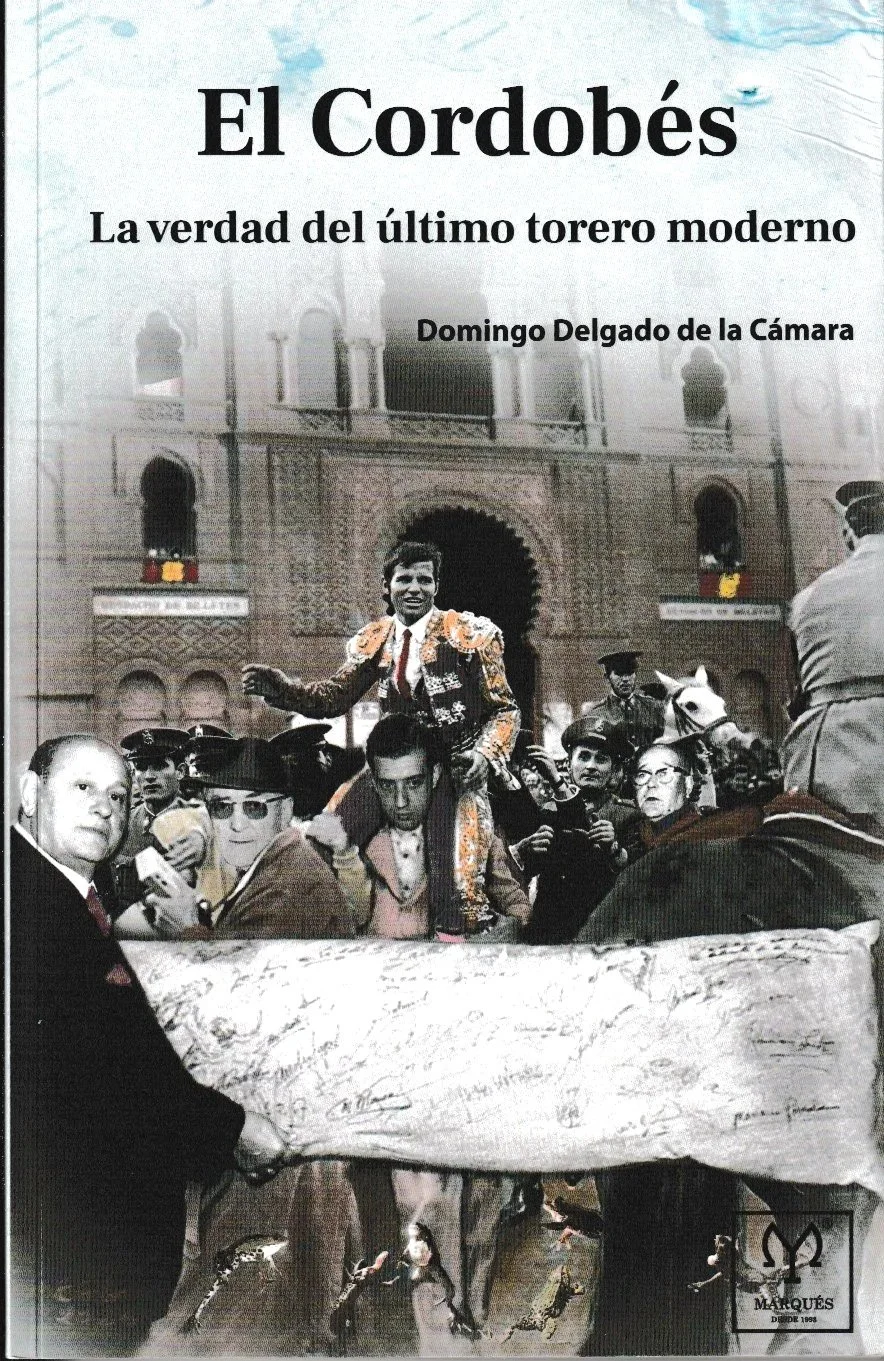
Yes, that’s Antonio Ordóñez carrying El Cordobés on his shoulders and leaping frogs on the book’s cover, but this is a serious tome
It may come as a surprise to some aficionados that the interesting taurine author, dogmatic Onetoro commentator and archetypal gallista, Domingo Delgado de la Cámara, holds a high opinion of Manuel Benítez El Cordobés.
The stage was set in de la Cámara’s first book, ‘Revisión del Toreo’ (2002), based on viewings of toreros in action, where El Cordobés is accorded the status of a matador who passed the bulls more closely than most, and whose left hand could only be compared with that of Manolete, the later Cordoban’s quietud and ability to link passes making him “un torero de gran pureza”. But that book also describes El Cordobés as a torero “sin clase” whose toreo is “ugly and coarse”. So, which is really the case?
De la Cámara’s new book takes the form of, first of all, a more detailed look at El Cordobés’s career, focusing particularly on his performances in the first class bullrings, and secondly, a robust defence of Manuel Benítez against the criticisms that many aficionados made and still make of him. Here, de la Cámara makes a distinction between the Cordoban’s toreo and his alardes, which he admits are a matter of taste. So Benítez is both classically inclined in his concept of passing bulls, but a non-conformist when it comes to other aspects of his presence in the bullrings.
In covering Benítez’s career, de la Cámara states, “El Cordobés dominated toreo in his time because he got closest to the bull, kept still and linked more passes than anyone else.” He highlights the torero’s phenomenal bravery - tested through numerous tossings - saying that, although his style of tremendismo had its copyists, those toreros failed to make any headway because they lacked the original’s valor.
In his defence of Benítez, de la Cámara confronts the criticisms of the matador’s detractors head-on. El Cordobés’ success for almost a decade was not due to propaganda, but rather his bravery in the bullring and willingness to put his life on the line. He was not a “torero de franquismo” because the dictatorship, in comparison to its support for football, tended to ignore bullfighting. Yes, there was fraud during El Cordobés’ time, but this had long existed and could not be laid at the matador’s door - indeed, the other matadors of the day took advantage of the situation just as much as Benítez. While El Cordobés was criticised for his domination of la Fiesta, he (unlike, for example, José Tomás) used his position to appear as often as possible and earn as much money as he could, an approach that meant other toreros benefitted as the numbers of corridas, and with this their earnings, shot up. Benítez’s so-called “anti-aestheticism” arose because of the snobbish nature of many aficionados: in de la Cámara’s view, “El Cordobés restored the most primordial, most ancient essences of la Fiesta [… and] revived toreo’s most essential element - bravery,” while many Spaniards of his time liked his personality and were attracted by his charisma. The view of Benítez as someone who corrupted toreo is countered by his continuation of Manolete’s legacy - stoicism and linked passes - while citing to the pitón contrario instead of to the nearer horn.
“Two toreros dwelt within El Cordobés,” writes de la Cámara. “There was one that was stoic and vertical, totally related to Manolete. This was the torero who appeared on the most demanding days in Madrid, Sevilla and Bilbao. And then there was another that ended up completely sweeping away the first, totally histrionic and excessive. But people laughed at these excesses because beforehand he would torear en redondo very well, especially with the left hand.” De la Cámara admits to liking El Cordobés’ excesses too, describing the matador’s mounting of a bull in Jaén on October 18 1970, as the ultimate invasion of the bull’s terrain.
Towards the book’s end, De la Cámara describes Manolete as the first modern torero and El Cordobés as the last: “Postmodern toreo has occurred since Benítez, consisting of an improved and virtuous version of what has already been done by others, he having brought adjustment in passes, linking and the invasion of [the bull’s] terrains to their ultimate limits.” For those wanting further explanation, the author says he will write about postmodern toreo at a later date - something to look forward to.
In the meantime, his views on fraud in today’s corridas are clearly expressed: “Speaking of the existence of fraud, it’s never been as bad as now. These days, even in the most important plazas, bulls come out with “la bolita” [the tips of their horns rounded] practically every day. You can count on the fingers of one hand the ganaderías that don’t permit this and the bullrings where bulls are fought “en puntas” [with unmanipulated horns]. Right now, fraud is running rampant because the authorities and governing bodies have given up and no longer take steps to combat it. Because of the way in which evidence is kept and the presumption of innocence, the administrative litigation judges have prevented the imposition of any sanction, and, what is worse, have totally demoralised the authorities, who no longer send off horns for analysis. And so the fraud flourishes with total impunity, in an atmosphere of general resignation. Everyone has got used to la bolita and now doesn’t even protest against it. La bolita has revolutionised the world of fraud. As you just smooth the horn tip and don’t remove anything material, the horn passes analysis as well as if there had been no manipulation at all. And this has meant that the fraud has extended to all the bullrings, including the most important ones. Up until la bolita’s arrival, horn-shaving was cruder and was something that occurred in second and third-class plazas, but hadn’t crossed over to the top category rings. But now it has. What’s more, the authorities don’t appear to have any real appetite for tackling the issue.”
To round out the book, there are statistics on El Cordobés the novillero and the matador, including lists of his festejos, although it is a shame that the lists comprise carteles without showing the days’ end results.