Hotting up - the implications for bullfights
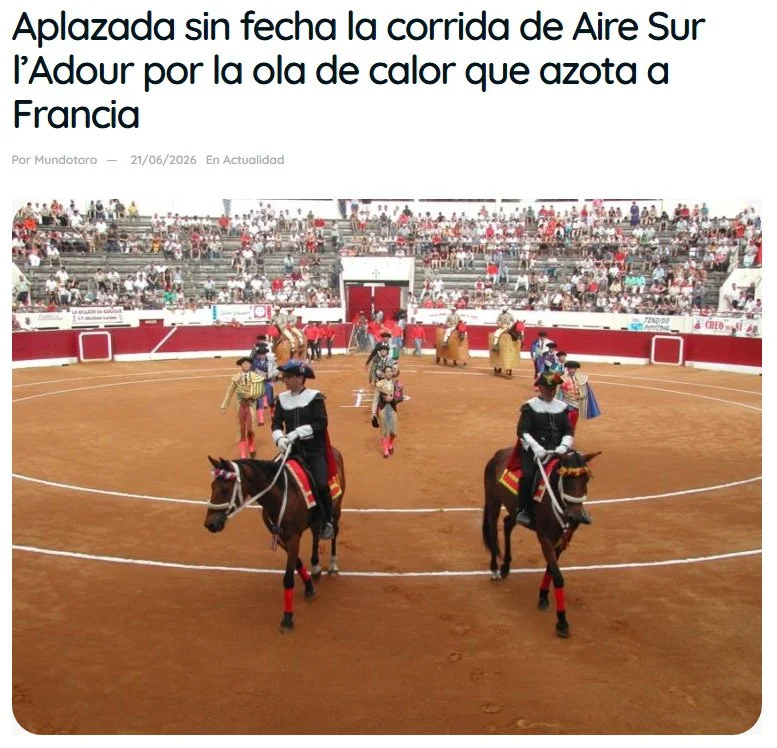
Mundotoro’s announcement of the cancellation of Aire sur l’Adour’s June 21 corrida
On June 21, French authorities, forecasting temperatures to rise above 40C, placed more than a third of the country under a ‘danger to life’ red heat alert. France’s Culture Minister, Catherine Pégard, gave local authorities responsibility for deciding whether festivities and other outdoor events should be cancelled or take place with suitable precautions. The Guardian reported that most opted for the latter, but at Aire sur l’Adour the corrida of Adolfo Martín bulls for José Garrido, Álvaro Lorenzo and Solal Calmet Solal that would have marked the 10th anniversary of Iván Fandiño’s death in that same bullring was cancelled indefinitely, the prefect of Les Landes having decided to prohibit all outside sporting and cultural activities.
The night before in Madrid, 7,234 spectators (a third of the plaza) turned up for a corrida nocturna in Las Ventas that saw the albaceteño Cristián Pérez (badly gored in Las Ventas in the run-up to San Isidro) very nearly go out the Puerta Grande after winning an ear from his first Valdefresno bull, then suffering a bad tossing, recovering and losing an ear with the sword on his second.
It’s unusual for corridas to be cancelled or postponed due to hot weather, but the likelihood, given the effects of climate change, is that this will become more common. Apart from the discomfort to spectators and toreros, there is the impact on the bulls to consider. In the final very hot week of Madrid’s Feria de San Isidro, for instance, there were concerns voiced about the effects of dehydration on the bulls and the bulls that fell during Borja Jiménez’s Corrida In Memoriam didn’t just fall - they collapsed.
The easiest response would be to move festejos back to later in the evening, when there may still be heat, but to a lesser extent and without the sun shining as well. Later start times may well become more common, although some bullrings would need to install lighting or improve their existing lighting to enable corridas nocturnas to take place and spectators would need to adjust to the change in habit.
A more radical response - one which empresas will be keen to avoid if at all possible, but which may become necessary over time - would be to move Spring and summer ferias to other times of the year. This would involve substantial changes to the international taurine calendar, although the decline in importance of the various Latin-American temporadas and the ease of travel across the Atlantic Ocean perhaps make this option more feasible than before. But it also carries with it a substantial risk, as maximising corrida attendance has traditionally been linked to holding them during local ferias, many of which have been built around the Catholic calendar of saints’ days, and attendance at corridas held outside these times has often been poor. On the other hand, ferias are very much about local communities coming together and enjoying themselves, traditionally outdoors, and if the spring and summer weather reaches a point where it no longer permits this to be done safely, the case for shifting ferias to other times of the year will be strengthened.