Valencia’s Gran Feria de Julio (well, not really)
Pieter Hildering
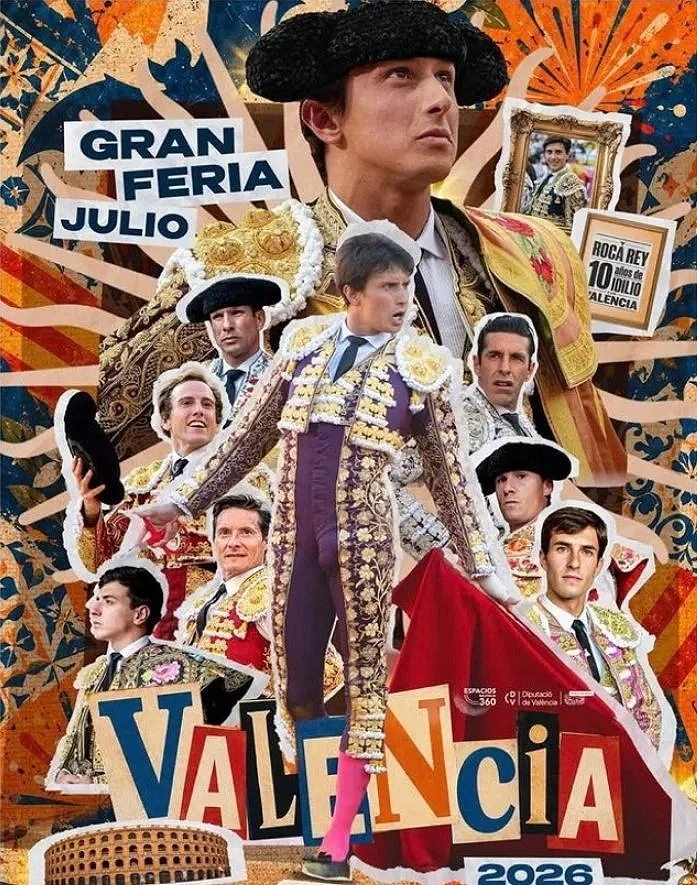
Detail of the feria cartel (Image by Pieter Hildering)
Two corridas, a novillada and a corrida mixta, that’s all there was in this year‘s mini Feria de Julio, the once ‘most important feria of the summer’. It used to be. When I first came to Valencia in July 1981, it lasted 10 days and had two novilladas, eight corridas, a corrida de rejones and ended with the traditional miurada. It was the first and only time I saw Christian Montcouquiol Nimeño II place sticks on Camacho bulls.
Another name for the July Feria was la Feria de San Jaime, celebrating Saint James the Apostle, known as Santiago, whose saint’s day falls on July 25. Novilleros Pepín Jiménez, Vicente El Soro and Luis Miguel Campano helped us honour that day all those years ago. But for some time now, San Jaime’s day is no longer included in the feria and Miura bulls are a rarity in Valencia.
Valencia’s July feria is also known for its traditional ‘desencajonada’, its public unpacking of the animals for the corridas of the Feria. It usually starts around 11 o’clock at night and many people come to watch. In the ring, neatly placed along the wooden barrier, stands a row of large wooden crates, each holding a bull. Six crates per ganadería. When the first crate is slid open and the first of six bulls are let out into the arena, the air is electric. Some bulls come out slowly, a bit dazed by the journey and the long wait in their cramped housing; others shoot out like a projectile from a cannon. Desencajonadas are a great way to see what animals a breeder has sent to the arena. Preparations begin early as a forklift has to take all the crates off the lorry and place them on the sand. However, this year, Code Red prevented the tradition from taking place. With temperatures above 30 degrees, it would have been impossible for the bulls to stand in their crates in the blazing sun all day. It wouldn’t have been the first time a bull suffocated in its box during a desencajonada in Valencia.
Thursday July 16, a corrida mixta
On July 16, the feria got underway with the corrida mixta, one of the many varieties of the taurine events. I have never understood the reason for combining two matadors de toros with a novillero. I have seen many different combinations like a matador, a novillero and two rejoneadors, even four rejoneadors and one matador. I remember novillero Julio Aparicio was cast in two corridas mixtas a year before his alternativa in 1990. Maybe that told us something about one of the participants of today’s mixta: novillera Olga Casado. Was this the way Olga’s management tried to tell us that she was being prepared for her alternativa? Later on this season? It got curiouser as I noticed that, among the portraits on the feria’s cartel, Olga’s face was missing. But there seemed to be a reason for that: initially she was to appear in the novillada on July 19. When they came up with the idea of placing her in a more lucrative corrida mixta – with two Valencian matadors by her side – the artwork was already printed and Olga was left out.
She made her Valencian debut with Román (Collado) on her left and Nek Romero on her right side. The toros came from Fraile de Fresno: the two novillos were Montalvo. Our good friend Álvaro de la Calle acted as sobresaliente for the two matadors, while two anonymous novilleros stood in for their colleague should anything happen to Olga. In spite of this attractive line up, the plaza was only half full.
The bull opening the Feria was a well-armed, large, muscular animal of 580 kilos named ‘Marqués’. As it jumped into Román’s welcoming cape, I thought it wouldn’t stay on its feet very long. But, after receiving two skillfully administered pics (for which the picador was applauded) and reacting well to a quite of chicuelinas by Nek Romero, my first impression didn’t hold. Román opened his faena with a series of passes de rodillas then placed his bull in the centre of the arena and guided him through some great series over both horns, though the animal clearly preferred his right side. An unintended recibiendo kill almost went wrong when the bull’s right horn got Román by the hip and threw him in the air, fortunately without consequences. The sword was effective and the ever-smiling Román was given a well-deserved lap of honour.
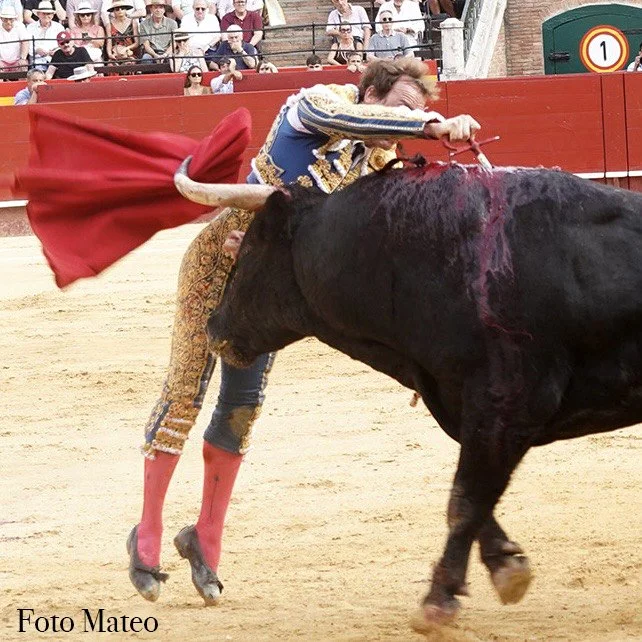
Román killing (Image Mateo)
His second bull was ‘Dudaguapo’, another good-looking Fraile bull weighing 552 kilos. But this one wasn’t going to give in as easily as its brother and it took Román a long time until he was able to construct a series of capotazos before the picadors came in. Two pics, followed by another remarkable quite by Nek Romero, didn’t change the bull’s reluctant behaviour. It allowed Román two muletazos before it took refuge at the side of the ring. Román carefully toreared the bull in its querencia in Sol and, although the estocada was slightly trasera and needed a descabello, the public rewarded their local hero with one of ‘Dudaguapo’’s ears.
The second bull of the evening weighed 538 kilos, was well presented, well-horned and Nek’s first opponent. Nek Romero (Nek Pérez García), the 23-year-old Valencian from Algemesí, got his alternativa in October 2024 from Enrique Ponce in the maestro’s very last corrida in Spain. Since then, Nek’s career hadn’t been very succesful. Tonight was his second appearance in a plaza de toros since his promotion, and both times were in this arena. It is not very likely he will rise in the rankings, which is sad because he is not a bad torero. However, there are many toreros in that category.
This bull’s name was ‘Carafino’. But ‘Carafino’ had no intention to co-operate and it was only after the second, well-placed pic and the tercio of equally well-placed banderillas that it decided to be part of this spectacle. A brindis to Román got the faena underway and, to the surprise of everyone, the bull lowered its well-horned head and followed Nek’s muleta and the fine passes the matador offered. A pinchazo, followed by a media estocada, killed the bull, leaving Nek hoping his next bull would give him more opportunity to show his talents.
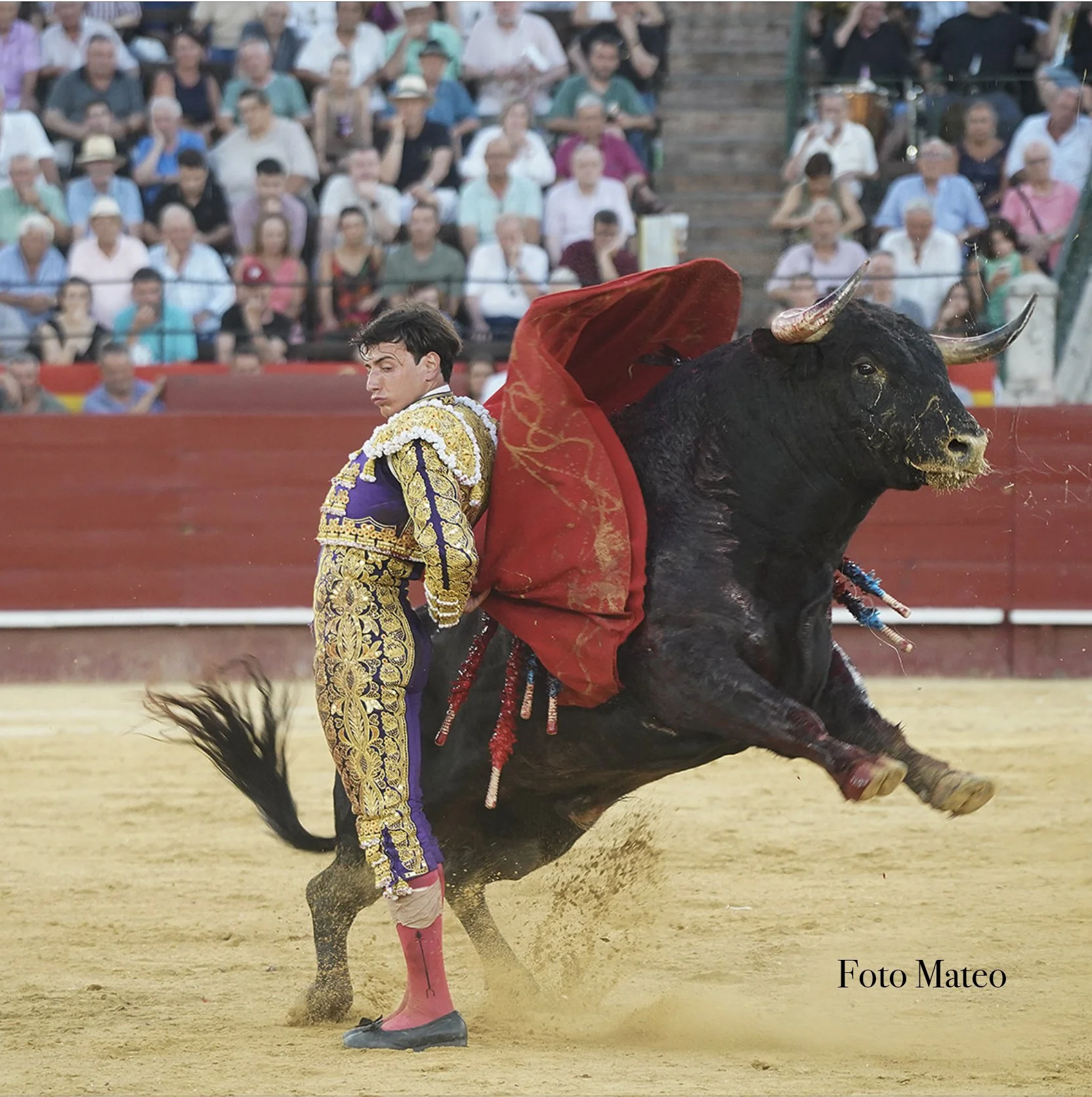
Nek Romero, a promising novillero now struggling for contracts as a matador (Image Mateo)
He was lucky. His next bull gave the young matador ample opportunity. After two meetings with the picador and a good series of banderillas, for which his cuadrilla received a resounding ovation, Nek took the bull to the centre of the arena. You could hardly tell that this was only his second corrida because the muletazos showed confidence and beauty. Nek Romero toreared his bull like a seasoned pro. Unfortunately, his sword missed the right spot and he needed a descabello to bring the bull down. It also took some time persuading the president before Nek’s excellent faena was rewarded with a well-deserved ear. Nek Romero moved up one small step of the ladder.
The first good-looking Montalvo novillo galloped onto the sand and quickly found Olga Casado’s capote welcoming it for a set of great verónicas. Her capework was excellent, as we got to see in a quite after the picador hit the novillo hard. I was impressed. She wasn’t playing the gallery; she concentrated fully on what she had to do. Suddenly, out of nowhere, the president decided to show the green flag and the novillo was taken out by Florito’s cabestros. “The novillo had a stiff leg,” it was argued.
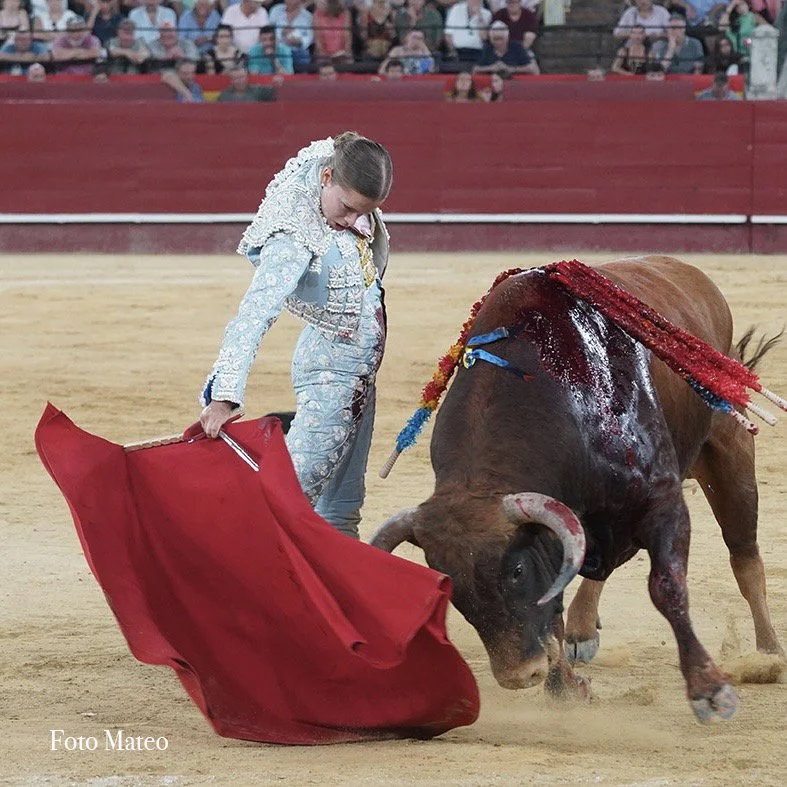
Olga Casado in a derechazo (Image Mateo)
The substitute was a light-brown novillo weighing 490 kilos, aptly named ‘Bombón’, that shot out of the toril on rails and contributed to some more great capework from the novillera. Then the rain came and, even though the warm, marble-sized drops could be counted on two hands, almost every tendido bajo emptied to seek shelter and those who stayed, conjured up an umbrella! I realised I had brought a large plastic bag which fitted snugly on my head. The rain lasted two minutes, and nobody got wet, but, because of the panic and people moving in and out of their seats, I can only tell you about Olga’s faena. Her muletazos had great quality and it was much appreciated when she treated the Valencian crowd to two perfectly-executed poncinas. At that point, the novillo decided it had had enough and fell down at the next shake of the muleta. She lost a trophy for a bad sword and needed a descabello to get the bull down.
Her last Montalvo novillo was again met by great capework, but it soon became clear that the animal was no match. It stumbled through the faena and gave up after the first muletazo. Olga Casado left the ring empty handed. The Montalvo novillos had been a disaster for the novillera, but she had shown great quality in the details she was allowed. I’m sure her management will do anything to help her and no doubt she’ll take her alternativa somewhere some day in the near future. I wish her all the best, but, looking at the history of women bullfighters, I’m afraid she won’t stand a chance. Which is a great shame.
Friday 17 July
Another scorching day with temperatures well into the 30s. This evening gave us José María Manzanares, Alejandro Talavante and Roca Rey with Juan Pedro Domecq bulls, and, in my seat in Sombra, it was quite agreeable with a slight breeze.
A good-looking black bull of 562 kilos charged José María’s capote and – while, according to comments from the crowd, the animal wasn’t all that steady on its legs – survived two well-placed, hard pics. Juan José Trujillo and his colleagues took care of the second tercio. During the faena, Manzanares did everything righ; the bull reacted how it was supposed to, but it all lacked depth. “No transmite,” as they say in Spain. The action on the sand didn’t connect with the tendidos. When the bull lay dead on the sand after a pinchazo and an estocada, there was no reaction from the crowd, with silence for Manzanares and silence for the dead bull.
Bull number four was 50 kilos lighter, but had a pair of menacing astifino and veleto horns with which it threatened to skewer everyone who dared approach it. It demonstrated its intentions by pushing hard into the horse’s harness, while undergoing the well-aimed punishment by picador Paco María, and survived the tercio de banderillas before José María led it to the centre of the ring to start his faena. The first series of muletazos strung together some fine, low-handed derechazos which turned the animal around beautifully and in position for the next charge. During the series of left-hand passes, however, the matador had to work much harder to keep the bull concentrated on his muleta as he wilfully sent him away with every sweep. So the faena mainly concentated on the right horn. His sword lost him the trophy. A media estocada and a descabello left the bull moribund on the sand, and, in spite of some nice details during the last tercio, José María left the arena in silence and went straight to the infirmary, where he was treated for heat exhaustion.
Alejandro Talavante saw a fine-looking colorado bull of almost 600K trot into the ring. Once the ritual capote welcome was over, it underwent one pic and Talavante and Roca Rey each took turns in quites. The bull didn’t mind, it was up for anything and once the tercio de banderillas was over and the matador had started his performance, the bull trotted through every combination of passes Talavante offered him. I found it a bit dull and thought Talavante stretched his arm a bit too much and sent the bull away on too many occasions. I might have got it wrong because, while my handkerchief stayed in my pocket, the gradas fluttered with white objects that convinced the presidenta to award the matador one ear.
‘Tramoyista’ was Talavante’s last bull, well-presented, well-horned and with much more spirit than his first. The matador welcomed it with two largas, followed by a series of chicuelinas. This bull was no pushover. It took two well-placed pics and received three sets of banderillas from the members of the cuadrilla. Talavante’s first series in the faena was a good set of right-hand passes and, although I do not like the way this matador handles them, this time his naturales were well-managed, with a bull that followed every move. But the faena went on too long and stalled, as if Talavante had run out of ideas; his toreo became boring. A pinchazo and a half sword brought ‘Tramoyista’ to its knees and got Alejandro lukewarm applause.
Roca Rey, the Rolls Royce of today’s taurine planet, got ready to Rocan Rol. The bull ‘Rasguero’ was a jabonero, one of the many hues of bulls that can be found in Juan Pedro Domecq’s herd. This beige, sand-coloured bull was heavily over-piced, while the matador from Lima performed a quite of several chicuelinas in between. After an adequate second tercio from his cuadrilla, Roca started his faena. To my surprise, there were no kneeling passes, no mindblowing pases por la espalda; there was nothing flash. Just a couple of well-linked series of right-hand passes, followed by naturales, and everything ended with appropiate pases de pecho. Roca Rey reformed? Someone must have told him to cut out the frivolity and start showing people he was capable of performing a clean faena. The only details that reminded me of ‘the old Roca Rey’ were the series of manoletinas and bernadinas, but everyone uses them today. Sadly, the sword went in the lungs and the bull sank to the ground vomiting blood. A well-placed descabello blade would have put the animal out of its misery straight away, but today’s mantra is that using the descabello loses you the trophy. In this case, he lost it anyway.
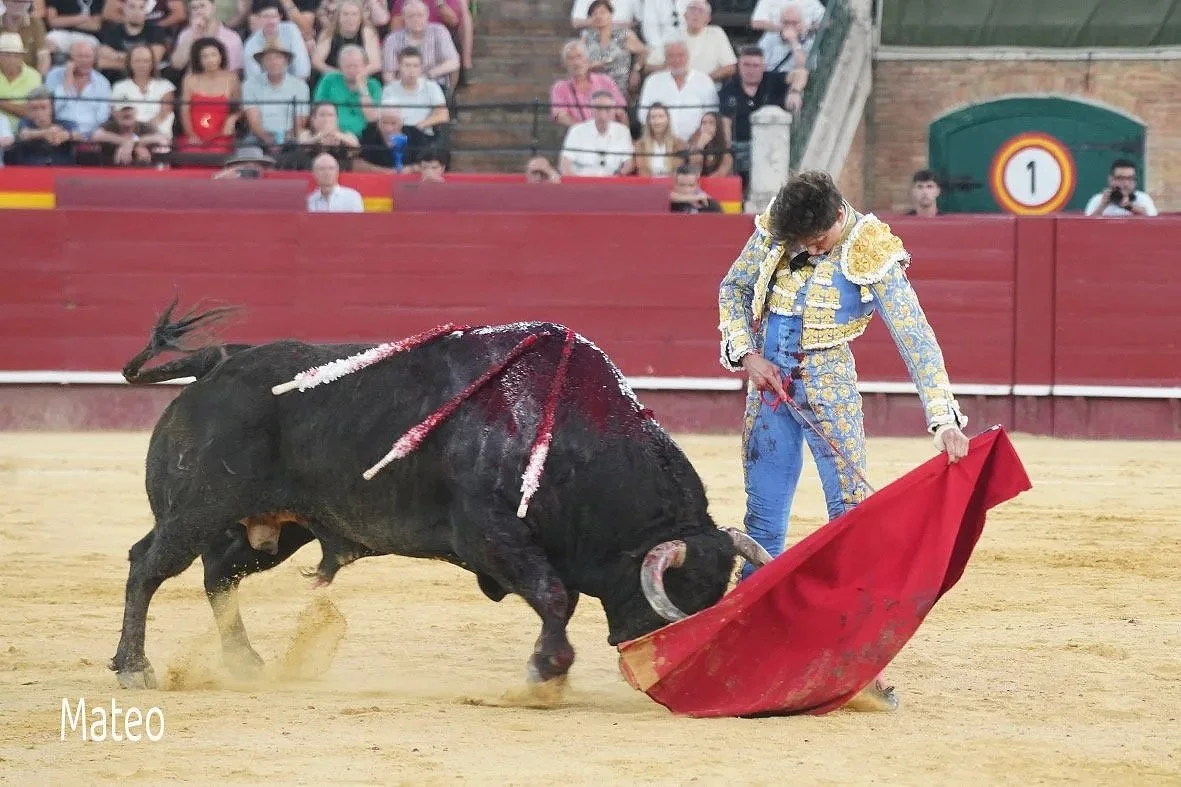
Andrés Roca Rey in a natural ayudado (Image Mateo)
The last bull of the evening was another good-looking, serious bull called ‘Tulipán’. When the animal lay dead on the ground, the crowd vigorously waved everything white to make it clear they thought that this faena had been worth two ears. So did I. Roca Rey’s last tercio was a wonderful experience of creativity, valor and understanding that dominated the bull with every pass from start to finish. A series of estatuarios led the bull to the middle of the arena, where the fiesta continued. Although the bull predominantly used its right horn, the slow derechazos were of a wonderful quality. With an occasional adorno thrown in, a molinete here, a farol there, the Peruvian never displayed the vulgarity known from his earlier temporadas. It made me think of Joselito after he stopped placing banderillas, or El Juli without his lopecinas. If this was the start of a new phase in the career of Roca Rey, it had my blessing. However, the presidenta didn’t think the same way. In spite of an estocada ‘hasta la bola’ (although a bit trasera) and a majority of white hankies, cushions and handbills, she only showed one white handerchief. Like Tomás Rufo in March, Roca Rey was denied the Puerta Grande by a presidenta. Female presidents will not be popular in Valencia for a long time, but later in the week ‘Tulipán’ was voted best bull of the feria.
Saturday 18 July
Veteran matador Diego Urdiales last appeared in this plaza de toros in March 2015. For more than 10 years, he was left out of the major Valencian ferias. Urdiales doesn’t bring in the crowds. The phones started ringing again when they carried him out of Las Ventas after this year’s Corrida de la Prensa. No doubt the contractors for the Feria de Julio were one of the many callers. But what had happened in Madrid hadn’t reached Valencia - the plaza was half-full.
His first bull was a lovely light jabonero of 564 kilos from Lola Domecq’s ganadería El Torero. It survived two heavy pics and felt the sting of four banderillas hanging from its back. Urdiales stepped out to dedicate the death of the bull to Mago Pepo. You might not know this gentleman - he’s a lawyer, but to Valencia’s many magic lovers, he is one of the best magicians in town. And an aficionado. Two years ago in Ondara, he made his debut as a novillero sin picadores in a festival which also featured Diego Urdiales. After the brindis, Urdiales led the bull to the centre of the ring and started his faena with a couple of gentle derechazos, followed by a series of naturales. Real naturales, executed with great temple, with the bull charging the inside of the muleta instead of the outer tip. There was nothing extreme, no kneeling, no faroles, just a faena of well-placed, slow muletazos that were politely applauded by the gradas. Urdiales would have triumphed had the sword hit its target, but he needed too many attempts to kill the bull, and, after retrieving his montera – Mago Pepo had not made it disappear – retreated to the callejón in silence.
It was not his day. The fourth bull was difficult to control with the capote and became dangerously manso after its run-in with the picador. It hardly reacted to the matador’s challenges, but chose its own moments to charge. Despite this, even though it seemed practically impossible, Urdiales managed to get some isolated derechazos from his adversary,. After an estocada atravesada, the matador’s valor received a mixed reaction from the crowd and Diego Urdiales thanked them from the rayas.
Daniel Luque got ready to receive his first bull, a well-armed, black animal named ‘Granadino’, weighing a mere 513 kilos, which was applauded the moment it entered and sprinted around the ring. Luque’s picador gave the bull two well-placed pics and, in between, Samuel Navalón gave us a quite of chicuelinas as a little preview of what was to come later. The banderillas placed, Luque walked over to dedicate his faena to José Luis Benlloch, journalist, author and, until recently, director of Aplausos magazine, and led the bull to the centre of the ring. Even though it wasn’t the day, ‘Granadino’ was a birthday present to Daniel Luque, who didn’t have to apply any of his party tricks. The bravo bull charged every shake of the red cloth and reacted beautifully to muletazos on each of its horns - a delight to watch. Which was also the opinion of the poorly occupied gradas, who, after the estocada, demanded that Luque be awarded an ear. The matador walked a proud lap of honor showing his trophy.
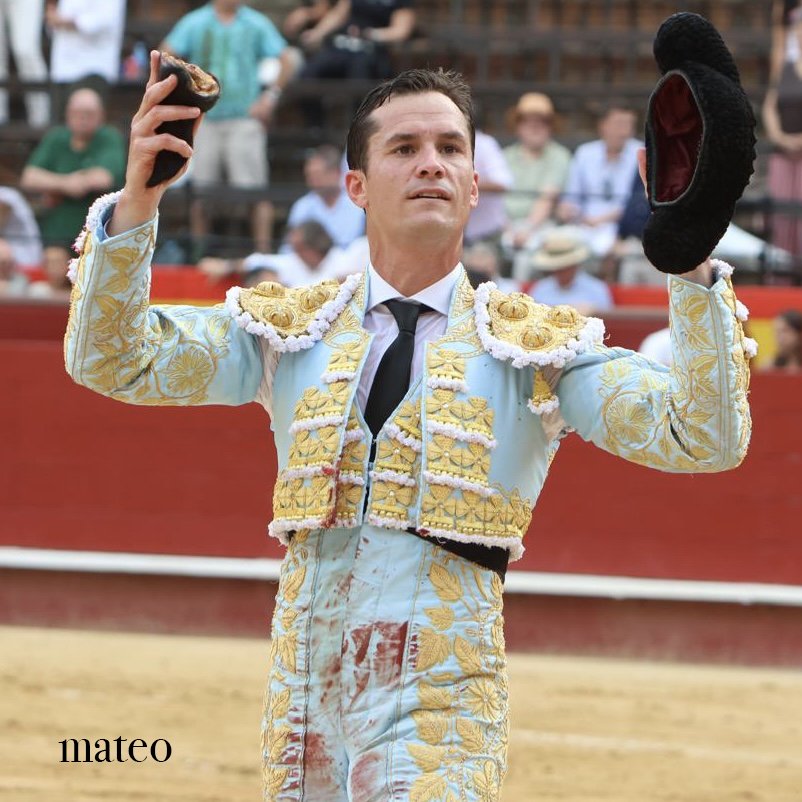
Daniel Luque on his vuelta (Image Mateo)
The fifth bull in line, the second for Daniel Luque, was another wonderful animal. A serious and bravo bull of almost 600 kilos, and with formidable upturned horns, it used its bulk to push hard against the harnessed horse and charged from well behind the lines in its second encounter with the picador. In between, its matador performed a great quite of verónicas, Navalón following with a fine group of tafalleras. Luque gave us a great faena, moving the bull around his body with serious passes, left as well as right, and pechos in between, while the animal gave him no time to slacken his concentration. In the past, I’ve seen matadors get rewarded after a pinchazo and an estocada casi entera, but today seemed to have different criteria. Hardly a white object fluttered, yet Luque’s valiant faena was rewarded with a resounding ovation, as was ‘Egipcio’ the bull while dragged to the matadero.
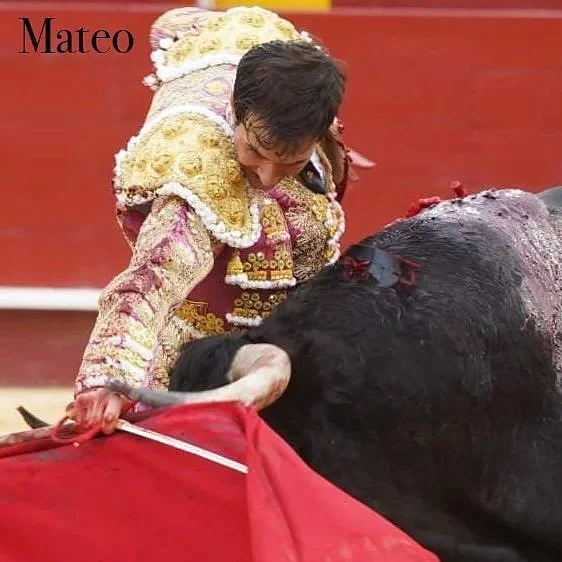
The first bull for 21-year-old Samuel Navalón was another big boy from El Torero who flipped over the picador’s horse and fiercely attacked the well-protected belly and legs of the helpless rocinante. (It needed six mozos to get it back on its feet.) I still find it amazing to see horses stay completely calm after they are knocked over by a bull. It’s as if they know they will be helped back on their feet. This was the bull Navalón was up against. Still, he calmy started his faena on his knees while you could see the bull was getting dangerous by the way it attacked the muleta and ripped it out of the young matador’s hands three times. But this didn’t faze Navalón one bit. He thought he was doing quite well until he was tossed in a bad way. After his concerned cuadrilla brushed the sand from their matador’s suit, he took off his jacket and continued as if nothing happened. The public loved it! His estocada went in slightly trasera, but to the cries of “Torero! Torero! Torero!” Samuel Navalón cashed in on his rather reckless performance and walked around the arena with the ear.
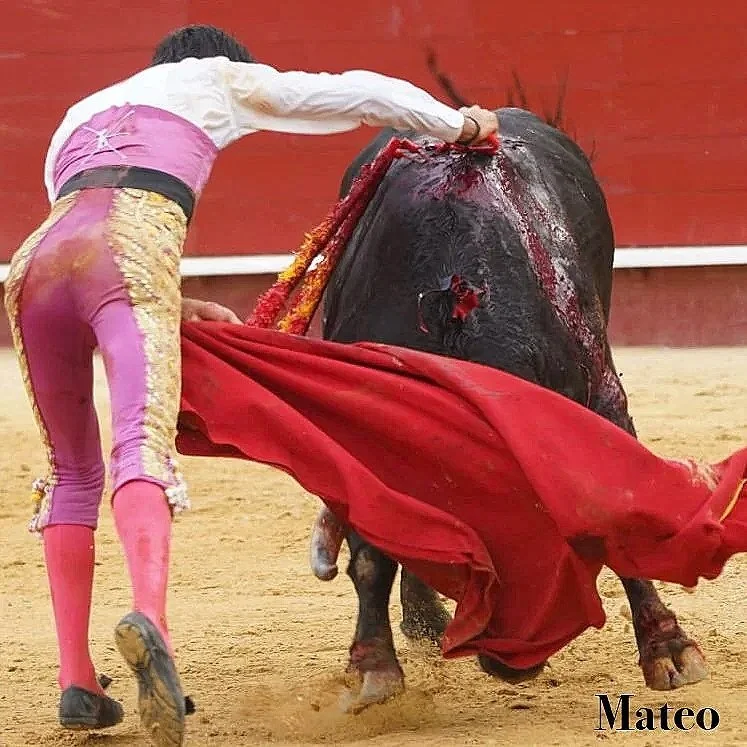
Samuel Navalón (above) with the estocada to his first bull and (below) toreando close to the horns (Images Mateo)
For his second performance, Navalón crossed the arena and knelt down in front of the toril door. When the bull, ‘Fulanillo’, shot out, it ran straight past him, almost knocking him over, and, accompanied by the applause of the crowd, sprinted round the ring. Once calmed down by capes fluttering from the burladeros and once Navalón’s capotazos had diverted its attention, ‘Fulanillo’ charged the picador from a distance. Twice.
At the start of the faena, Navalón gave the bull room to attack the muleta and captured it in some fine derechazos. In the following series, his muleta kept the bull close, Samuel performing some stunning passes behind his back. With the matador defiantly looking up at the public while doing a set of naturales, one could see his confidence growing. It was going too well. “He lost respect for the bull,” as they say, and the matador was on the horns again. His sword went in slightly caída, but when the bull dropped, two handkerchiefs hung over the railing. Navalón was about to leave the arena through the Puerta Grande. It was no wonder that, two days later, the judges nominated him as provider of the best faena of the feria (he was also the triunfador in this year’s Fallas). Strangely enough, the trophy for best ganadería was left void.
July 19, last evening of the mini feria
Today we had novillos from Alejandro Talavante, who started his ganadería 15 years ago with animals from Núñez del Cuvillo, later adding cattle from Garcigrande. They were waiting for Álvaro Serrano, Julio Norte and Marco Polope. An interesting line up: Alvaro Serrano was carried out of Las Ventas on shoulders in May this year; Julio Norte was voted best novillero of the recent Las Fallas; while Marco Polope is regarded as one of the rising stars of Valencia’s Escuela Taurina. He is the brother of Miguel Polope, an equally gifted novillero whom I saw many times, but who had to give up due to a chronic knee injury some years ago. The novillada started one hour earlier because of the final of the World Cup football between Spain and Argentina.
Álvaro Serrano was dealt the worst novillo of the evening, an uninteresting animal whose horn tips almost touched and which showed no interest in attacking the peto, but charged at anything else that moved. It underwent a second pic and seemed to liven up after the second tercio when Álvaro started his faena on his knees. These passes were followed by some right-handers in the centre with a bull that hobbled, rather than charged, through passes. It was killed by an estocada for which the novillero was awarded a vuelta.
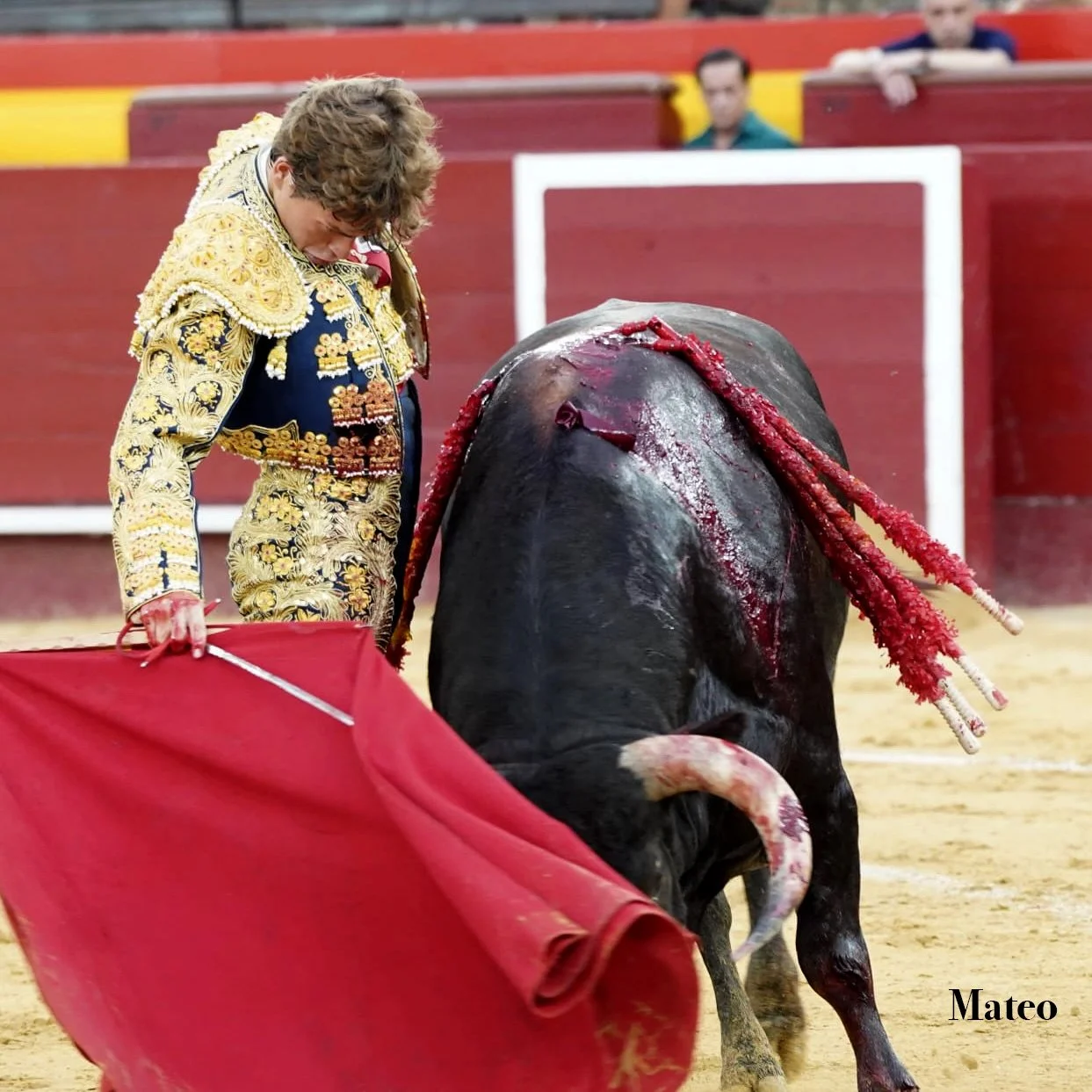
Álvaro Serrano (Image Mateo)
Serrano’s fourth novillo was the third sand-colored jabonero of the feria. A far better bull that endured one pic and reacted well to the proffered muleta once the faena started. Unfortunately, and as is usually the case when toreros need contracts, the faena went on far too long, while the estocada, though it killed the bull, resulted in a nasty injury to the novillero’s right hand. Clearly in pain, he walked over to the medical team, who established a broken finger; Álvaro Serrano left the arena in discomfort and in silence.
No doubt Julio Norte came back to Valencia to repeat his victorious performance of four months ago when he cut an ear each from two Fuente Ymbro novillos. His first bull was far better presented than its predecessor, and also reacted better to the offered lures. After some isolated capotazos led the animal to the horse where it was well piced, the banderillas brought it back to reality and Norte took it to the centre of the arena. He started his faena with some pases a rodillas and some well-linked derechazos. These were followed by a series of naturales. It went well, too well. It took one moment of carelessness and young Julio was on the horns. No harm done, he continued his faena with a series of redondos and endless muletazos which gave the bull time to understand the game and catch Julio Norte on the horns once more, but again without consequences for the novillero. The sword was used well and, in spite of the majority waving white, Norte was restricted to a vuelta for his troubles.
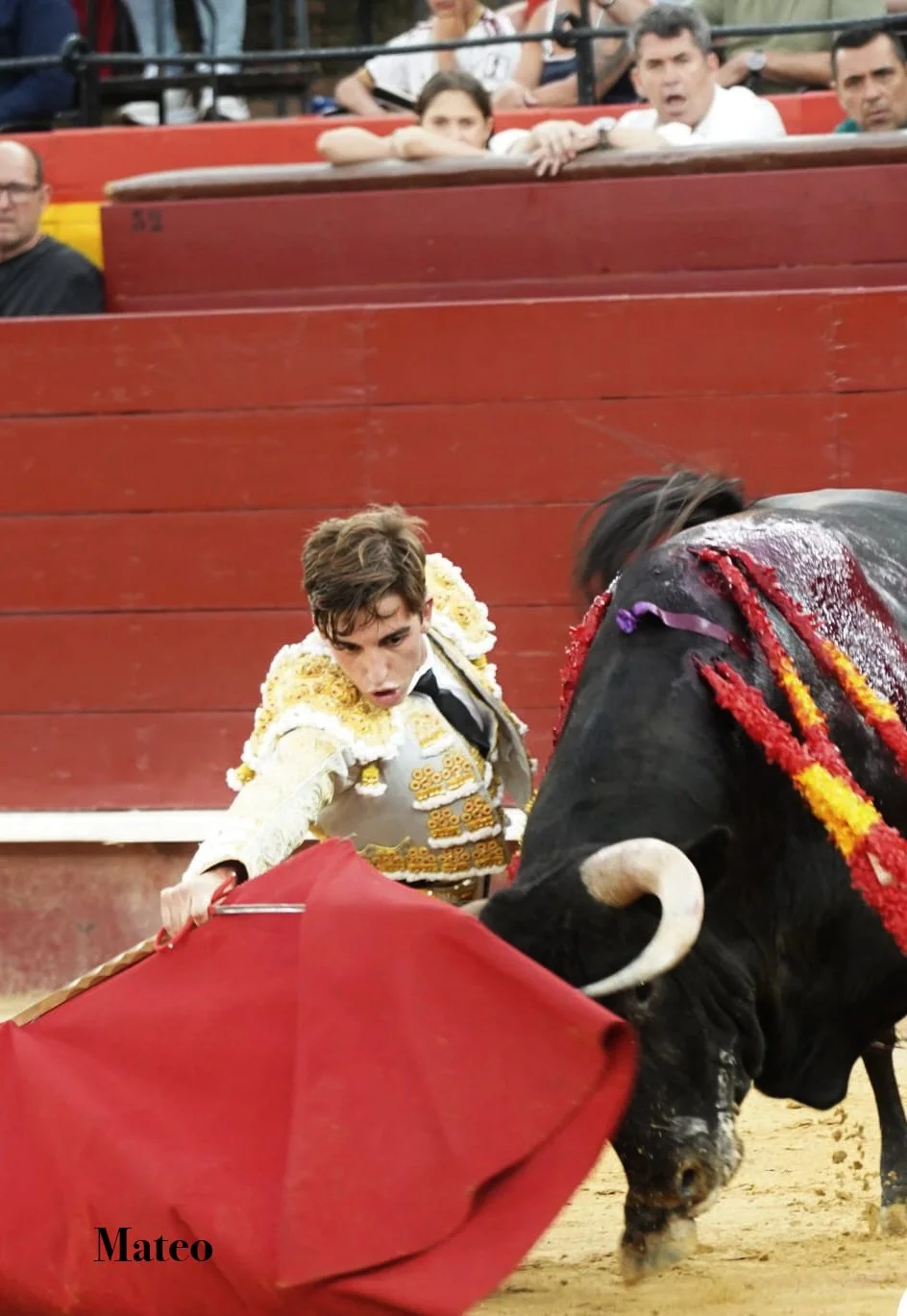
Julio Norte with a derechazo from on his knees
The fifth Talavante novillo pushed hard against the horse during the only pic it took, followed by a well-appreciated quite from Polope. Norte was back on his knees for the start of his faena and rose to his feet for series of right-hand passes to which the bulll seemed to protest. In my notes, it says the faena went from más to menos as the power of the bull ebbed away. Julio Norte received an ovation after the sword went in slightly trasera.
The first thing I noticed when the paseíllo reached the barrera was the presence of two figuras. Marco Polope had reinforced his cuadrilla with the excellent Raúl Martí and the exceptional Fernando Sánchez. It either showed they had great faith in their young protégé or he was well backed. ‘Cuentista’ weighed 510 kilos and charged the horse from a distance, but did not push, and, after Fernando Sánchez’s banderillas reminded us once more of the great Manolo Montoliú, Marco Polope started his faena. Although I had designed several posters which included the name of Marco Polope, I had heard of him but never seen him before. I’d seen his brother Miguel, who had a somewhat aloof, ‘manoletesque’ style of toreo that was not always appreciated by the crowd. So I wondered how Marco would confront his novillos.
I was not disappointed. Although you could see some of his brother’s influence, he was less upright when he guided his bull to the centre with some fine series of derechazos. Once there, he left the animal to recover and continued by citing the bull from a great distance to which it – almost gladly – responded. Even while drops of warm rain once again tried to disrupt the faena, the novillero worked his magic. This great faena by Marco Polope unfortunately ended with a metisaca and an estocada and no reaction from the public. But he had made his mark.
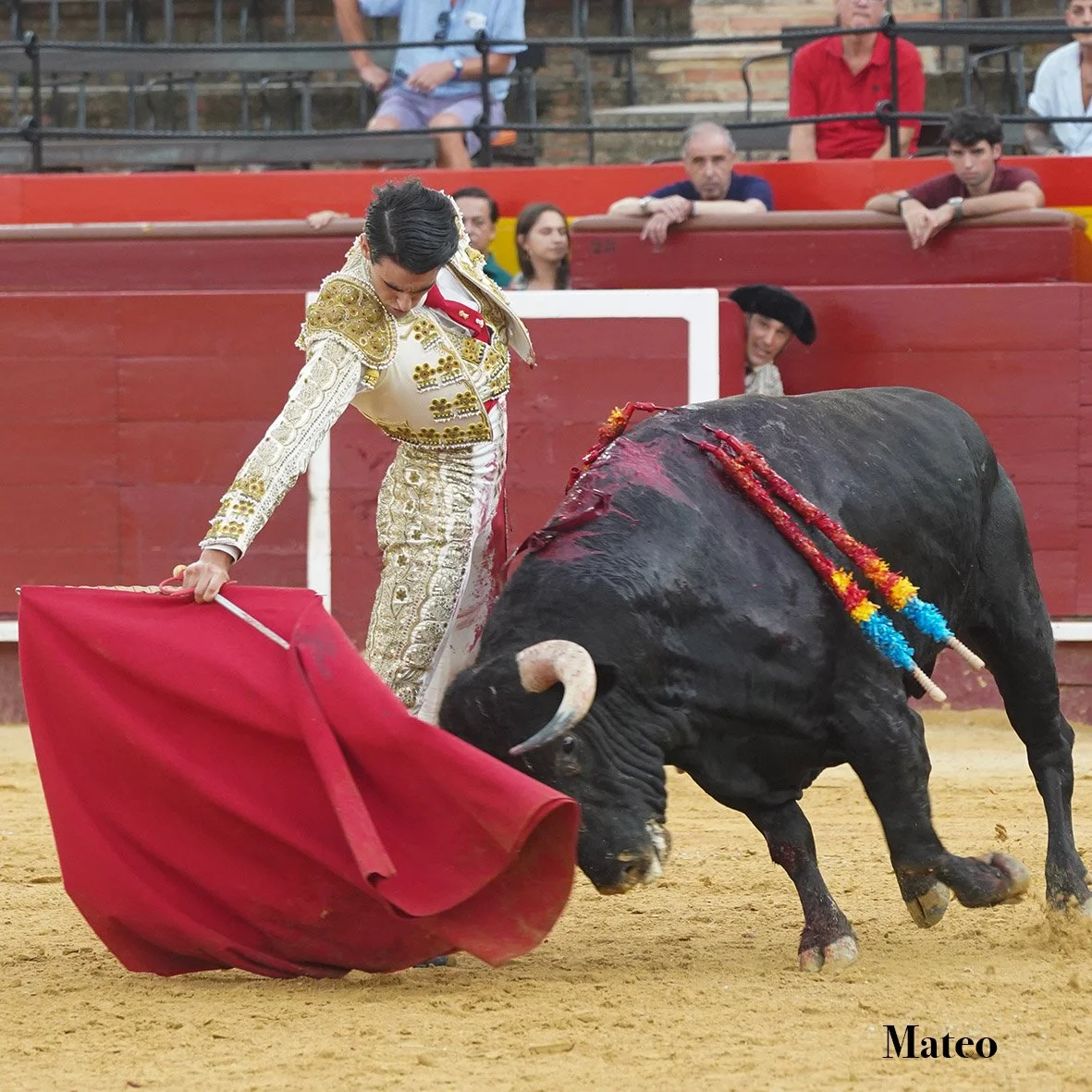
Marco Polope toreando: Fernando Sánchez giving advice from the burladero (Image Mateo)
The last novillo of the feria was yet another jabonero, well-built and muscular. Some concentrated verónicas led the bull to the horse, while the novillero shared a great tercio de banderillas with Fernando Sánchez. His faena was a delight of slow passes over both horns with an obedient novillo following the muleta as if it were on a string. For someone doing a report on a feria, there are moments when he forgets to write down what he sees. Marco Polope torearing his second novillo was one of those moments. But I can assure you that, if the sword had gone in better and he hadn't had to use the descabello, his rewards would have been far greater than a lukewarm applause. Marco Polope was voted best novillero of the feria.
Meanwhile the streets of Valencia filled with happy football fans wearing Argentinian and/or Spanish jerseys and gathering around giant television screens (Number 19 – Lamine Yamal – seemed to be favorite with the Spanish, while 10 – Lionel Messi – was most worn by Argentinian fans). Valencia’s July Feria was over, but I was convinced there were more celebrations to come later that night. The following day, I escaped the heat.