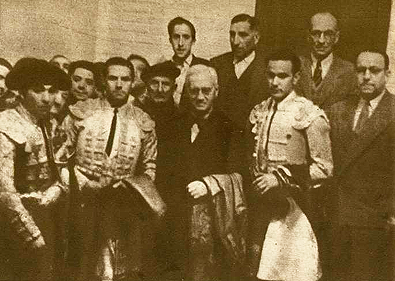
May 30, 1948: Sir Alexander Fleming (centre) poses with matadors Pepe Bienvenida, Mario Cabré and Pedro Robredo (Image from El Ruedo)
In 1948, Sir Alexander Fleming, who had been awarded a Nobel Prize three years earlier for his discovery of penicillin, spent 19 days in Spain, principally as a result of an invitation from Barcelona’s town council. The visit received huge publicity in Spain - smuggled supplies of the antibiotic had first arrived there in 1944, shortly after its initial mass production in preparation for the D-day landings. The first official batches followed a year later. In the Spanish Civil War’s legacy of a broken health system, widespread poverty, high infection rates and social taboos around sexually transmitted diseases, the Franco regime, looking to establish Spain as a self-sufficient modern state, viewed penicillin as a miracle cure. The regime initially focused on controlling penicillin’s distribution through health authorities, who reserved supplies for military and elite use. Later, it became a state-controlled symbol of recovery, with most sales occurring over the counter without prescription.
At the time of Dr Fleming’s visit, there was still very little penicillin available in Spain, but the Franco regime used publicity about the visit as state propaganda for the potential of the antibiotic. Fleming represented the great hopes that Spaniards placed in the drug, even though the vast majority of the population still had no access to it. His visit also represented a breach in the country’s post-War isolation (a trade agreement was being negotiated with Britain at the time) and his reception resonated with the prevailing national Catholicism. The public acclaim for the doctor consequently bordered on religious adulation.
From the moment Dr Fleming stepped off the plane in Barcelona, he was mobbed by members of the public, by well-wishers, scientists and physicians, politicians and public figures. Patients who had been treated with penicillin inundated him with expressions of gratitude. He was given letters and poems lauding him as a magician, a hero, a saint. Everywhere they went, Fleming and his wife Sarah were followed by cheers and applause, and laden down with flowers and gifts. His visit was celebrated in national newspapers and newsreels. He was invited to broadcast to the nation on public radio and spoke to packed halls in institutions across the country. The Minister of Education awarded him a medal, apparently at the special request of Franco. “Had I been visiting royalty or Winston Churchill,” Fleming wrote after the visit, “I could not have been more widely acclaimed.”
His 12 days in Barcelona were based around a series of conferences at the Hospital d'Infecciosos and la Real Academia de Medicina, where he was made an Académico de Honor. But the doctor also found time for other official events (including a reception at the Instituto Británico) and visits to parts of the city.
On May 30, following an excursion to Montserrat, he attended a friendly football match between Spain and Ireland at the Montjuich stadium, and then, with his wife, spectated at a corrida at Barcelona’s La Monumental bullring. This must have been a somewhat arduous experience because, to avoid clashing with the soccer match, the corrida was timed to begin at 11.15pm and did not finish until 2am! The spectacle featured five bulls of Muriel and a sobrero of Sánchez Valverde for Pepe Bienvenida, Mario Cabré and Pedro Robredo. However, reporting in El Ruedo, ‘Don Ventura’ said that the only ovations were for Pepe Bienvenida’s banderillas and for Dr Fleming, to whom Bienvenida and Cabré dedicated their first bulls.
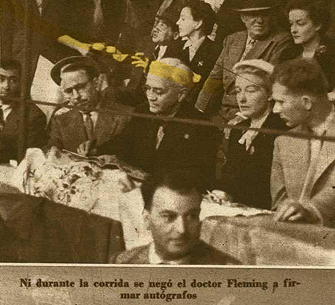
(Image from El Ruedo)
Six days later, Dr Fleming returned to La Monumental to see a sold-out novillada of Alicia Cobaleda bulls for Juan Tarré, Juanito Bienvenida and Julio Aparicio. Unfortunately, the animals were generally poor, El Ruedo reporting the afternoon’s highlight as being Aparicio’s faena to the last of the six.
Penicillin and bullfighting
Penicillin would, of course, have an important part to play in the world of los toros. Prior to its use, toreros who had received gorings would frequently die or lose limbs because of bacteria on the bulls’ horns transferring deep into their bodies. The first bullfighter to be treated with the antibiotic was Julio Pérez Herrera El Vito in 1946 following his goring by a bull of Álvaro Domecq at Jaén’s old ‘La Alameda’ bullring. When a priest visited him in hospital to give him Extreme Unction, the 20-year-old is reported as saying, “Padre, I want the Extreme Unction, but I also want la penicilina!” His wish was granted and the torero survived.
On the same day that Dr Fleming attended the Barcelona novillada, Pepín Martín Vázquez was gored in a corrida in Madrid. Interviewed by El Ruedo in hospital, the conversation went like this:
“Are you in pain?”
“Well, the worst is over… Now I’m, most of all, bleary. It’s my third cornada…. what bad luck!”
“Have you lost many corridas because of this?”
“A lot, yes. But I’m sure I’ll recover quickly and will resume my obligations. Nowadays, with penicillin, the injured heal quickly.”
“Do you have a lot of faith in la penicilina?”
“If it’s in the hands of Dr Giménez Guinea, absolute faith.”
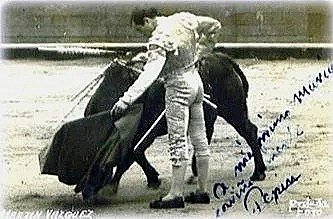
Pepín Martín Vázquez in action (Image from https://larazonincorporea.blogspot.com)
Contemporary views of taurine doctors
A week later, El Ruedo questioned a number of taurine doctors on their use of penicillin, including Giménez Guinea, who stated: “We’ve received powerful help with the discovery of penicillin. It wards off the danger of many infections. I’m not saying all of them, of course, because that would be a mistake — one that today, it seems, is gradually being overcome — that caused some doctors to fail when they insisted on considering penicillin as a universal cure-all.
“The bull's horn carries a lot of infectious germs. That's why the most important thing to avoid danger lies in the initial treatment given to the wounded. From the infirmary at the plaza, the torero leaves either on the way to recovery or in great danger, depending on how well that first treatment is carried out […] Penicillin is the best assistance in operations, although you can't expect it to work miracles when it's in inexperienced hands, because, as I've said earlier, it's not a remedy for all ills […] I think its effectiveness is better when applied in intramuscular injections than when used as a local treatment.”
El Ruedo spoke to an equally positive Dr Zumel, who was fresh from hearing a speech by Dr Fleming on the final day of his trip at Madrid’s Faculty of Medicine: “I believe that penicillin, after saving lives, is the discovery that can bring the greatest medical benefits to humanity. The method of using it is very simple, and the professor himself gave it to us in these four points - 1. Careful discernment of germs; 2. Know the routes of attack; 3. Know the precise amount that should be administered; and 4. Know the duration of the treatment. By adhering to these guidelines, success is guaranteed: stepping out of them exposes you to massive failure […]
“The truth is that, in the healing of horn wounds, the role of penicillin is secondary: it acts as an effective aide to the surgeon. But, for example in cases where gas gangrene occurs, penicillin alone wouldn’t be enough to stop the infection process […] However, since penicillin’s been used, many of the infection dangers that horn wound victims were previously exposed to have disappeared.”
Another interviewee, Dr Tamames, was also positive about penicillin: “It’s very effective in all traumatic cases, and wounds from a bull's horn certainly come into this category; it fights streptococci and staphylococci, and, especially when it comes to attacking aerobic and anaerobic germs, the results are excellent. It also prevents traumatic pneumonia, which used to appear so frequently in these cases before penicillin’s discovery.”
Fleming’s own views on los toros
From Barcelona, Dr and Mrs Fleming travelled to Sevilla, where they stayed at the invitation of the ayuntamiento. Sir Alexander was declared guest of honour and a street named after him. He visited the Real Academia Sevillana de Ciencias, where he was presented with the Academy's gold medal. He also visited the Las Cinco Llagas and Santa Caridad hospitals, the city’s cathedral and the Real Alcázar.
June 9 found the couple in Córdoba. Newspaper articles from the time recount how a crowd, including the mayor and a group of Andalucian dignitaries, gathered near the city's Roman bridge to welcome the eminent visitor. His journey from the Roman bridge to the mosque was "made very difficult by the constant cheers of the crowd surrounding him, who enjoyed the privilege of seeing him up close, applauding and cheering him incessantly," according to a 2023 article in ABC’s Córdoba edition marking the 75th anniversary of the visit. As in Sevilla, Dr. Fleming was guest of honour at an official reception at the city hall, where he gave a brief speech in English.
From there, Dr Fleming was taken to an exhibition of taurine art at Córdoba’s Palacio de la Facultad de Veterinaria. Here, he explained that he had only witnessed the two bullfights in Barcelona, with the night-time one occluding the true colourfulness of la Fiesta. At the exhibition, according to El Ruedo, “he fully understood what our spectacle really means. He had a thousand questions, some naive and others showing remarkable critical sense and perception, but where he was truly pleased and impressed was in front of the paintings that depict moments of bullfighting in the plaza. In front of them, he expressed his pleasure and admiration for la brava Fiesta.
“‘I was, in my youth,’ Dr. Fleming said, ‘a great enthusiast of a rather risky sport too: hunting. Over there, in Scotland, I killed several deer. But this tournament of colour and sound, of art, of courage, of tragedy and of death, seems to me to have extraordinary emotional power and a unique beauty.
“‘Until I visited this exhibition, I couldn't understand why bullfighting is so important in Spain. Now I understand it perfectly. And also why it has been a source of inspiration for the greatest artists.’”
Interviewed later by El Ruedo, the doctor was asked if he would become an aficionado. “For that, I would have to live in Spain for a longer period and attend many bullfights,” Dr Fleming replied. “My short and recent experience of bullfighting matters hasn’t been enough for me to understand the details of la Fiesta, knowledge of which is essential to be an aficionado.”
“And are you satisfied with the methods our surgeons use to apply penicillin in cases of horn wounds?”
“Completely. And very satisfied, what’s more, with the results obtained, thanks to the precision with which they apply it.”
Dr. Fleming died in 1955, six years after the death of his wife Sarah. His second wife, Amalia, whom he married in 1953, died in 1986.
The Las Ventas tribute
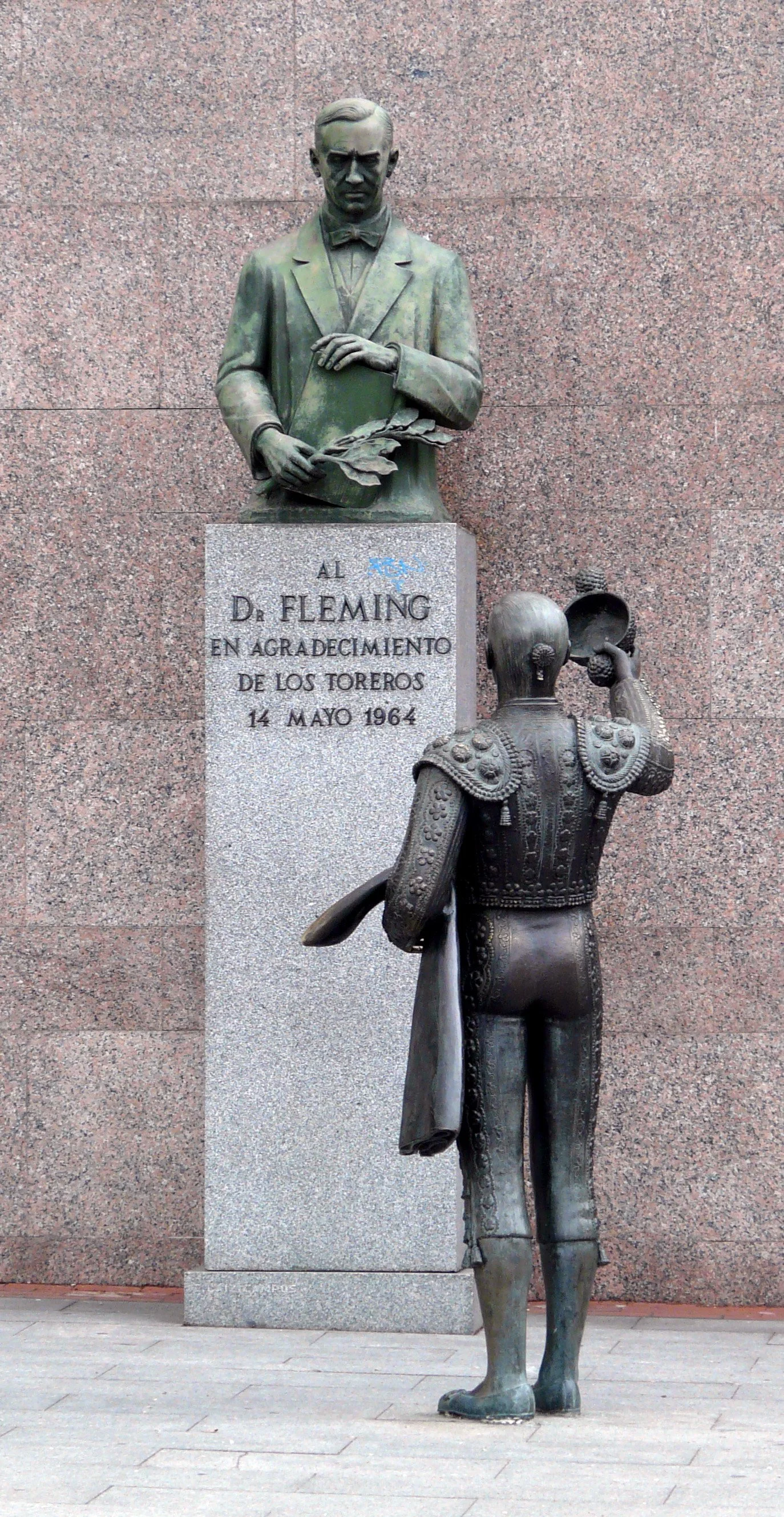
In February 1963, la Asociación y Montepío de Toreros (which ran the Sanitorio de Toreros) and la Junta de Gobierno de la Asociación Benéfica de Auxilios Mutuos de Toreros launched a public subscription to raise funds for a statue honouring Sir Alexander Fleming to stand outside Madrid’s Las Ventas bullring. On May 14, 1964, the statue was unveiled jointly by the mayor of Madrid and the British Ambassador in the presence of the entire board of the Montepío de Toreros, representatives of the Red Cross, several toreros (including matadors Raúl Villalta, César Faraco, César Girón, Rafael Pedrosa and Joselito Martín) and other representatives from the bullfighting world who decided to attend the event to show their gratitude to the distinguished microbiologist.
In the 12 months prior to this article of other taurine statues being inaugurated to Antoñete in Madrid, Rafael de Paula in Jerez and Dr. Val-Carreres in Zaragoza, it is good to record the contribution that a Scotsman made to la Fiesta and the gratitude he received in turn from toreros and from Spain in general.