
“What the great matadors have never said before about tauromaquia’s supreme suerte,” says the cover of this book focussing on the suerte de matar. And that’s pretty much correct; the last words on the subject came in José Luis Ramón’s ‘Todas las suertes por sus maestros’, published in 1998, when the matadors describing their killing with the sword were Rafael Ortega, Paco Camino, Pepe Bienvenida, Luis Francisco Esplá and Antonio José Galán.
Manolo Guillén’s book consists of interviews with 19 matadors (very brief ones in the cases of Ortega Cano and Andrés Roca Rey) and with Nestor García speaking on behalf of the late Iván Fandiño. At one point, the author was planning to present the collected information under themes - my first sword, training to kill, teachers and reference points, types of estoque, the suerte itself, dealing with periods of poor killing, etc. - but he finally decided to simply reproduce one interview after another, ordered according to the matadors’ respective dates of alternativa. This means there is a fair amount of repetition in the book, but it also gives the reader extended exposure to each matador’s contribution and a sense of the personality behind the printed words.
That the book begins with an interview with Francisco Ruiz Miguel is fitting because the torero was effectively mentored by Rafael Ortega, perhaps the reference point for today’s approach to killing. Other names - Paco Camino, José Miguel Arroyo Joselito, Ignacio Uceda Leal (the last two amongst the book’s interviewees) - are also frequently mentioned as inspirations for today’s matadors. José Antonio Campuzano tells (and is shown demonstrating in photographs) how his father-in-law Vicente Vega Gitanillo de Triana taught him the suerte de matar by having him practise entering over the back of a chair and adds that the best matador he himself has developed is Sebastián Castella: “When he wants to kill a bull well, he does so. And he used to be terrible with the sword!”
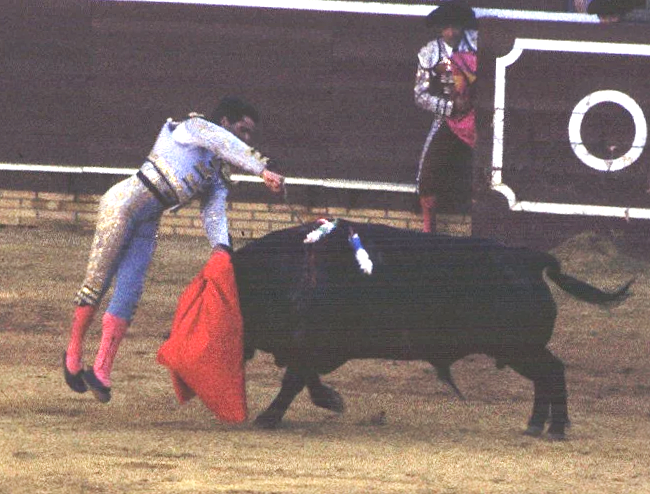
Paco Ojeda’s killing style
Individual idiosyncrasies are covered. Paco Ojeda describes how he used to jump up to kill because the bulls of his day tended not to be able to come forward by the faena’s end. Joselito’s style of citing with the estoque pointing upwards - a style favoured subsequently by several matadors - is described by the maestro himself as “a bad habit”, one that began when, as a becerrista, the bulls he faced were taller than him, although he also says that bringing the blade down from a height to enter the bull increases its momentum. Interestingly, when asked about being taught to kill in Madrid’s escuela taurina, Joselito responds, “My form of training kept changing, as the school had three teachers and each one taught me a different way of entering to kill”; it was really only after he took the alternativa that he focused on perfecting his killing technique.
Rafaelillo, of course, faced the challenge of killing animals that towered above him throughout his career. His training routine helped him with this: “The killing cart I train with is always two palms higher than others. I always tell the person handling it to lift up the ‘toro’’s head above the straw alpaca, the hypothetical morrillo, so that you don’t see anything apart from the bull’s raised head. Also, that way I can get used to waiting longer than normal so that I can see when it starts to come down. With the cart, I also tend to throw myself towards its rear to get used to passing and reaching that point. To do that is demanding, because Miura bulls have very long necks. If, as well as this, you take into account that I’m a pretty short torero - my limbs as well - so, in order to kill well, I have to expose myself more. You have to get closer to the horns and the bull’s cruz [the high point where the animal’s shoulder bones meet its spine], otherwise it’s impossible to cross with your arms and reach the killing spot.”
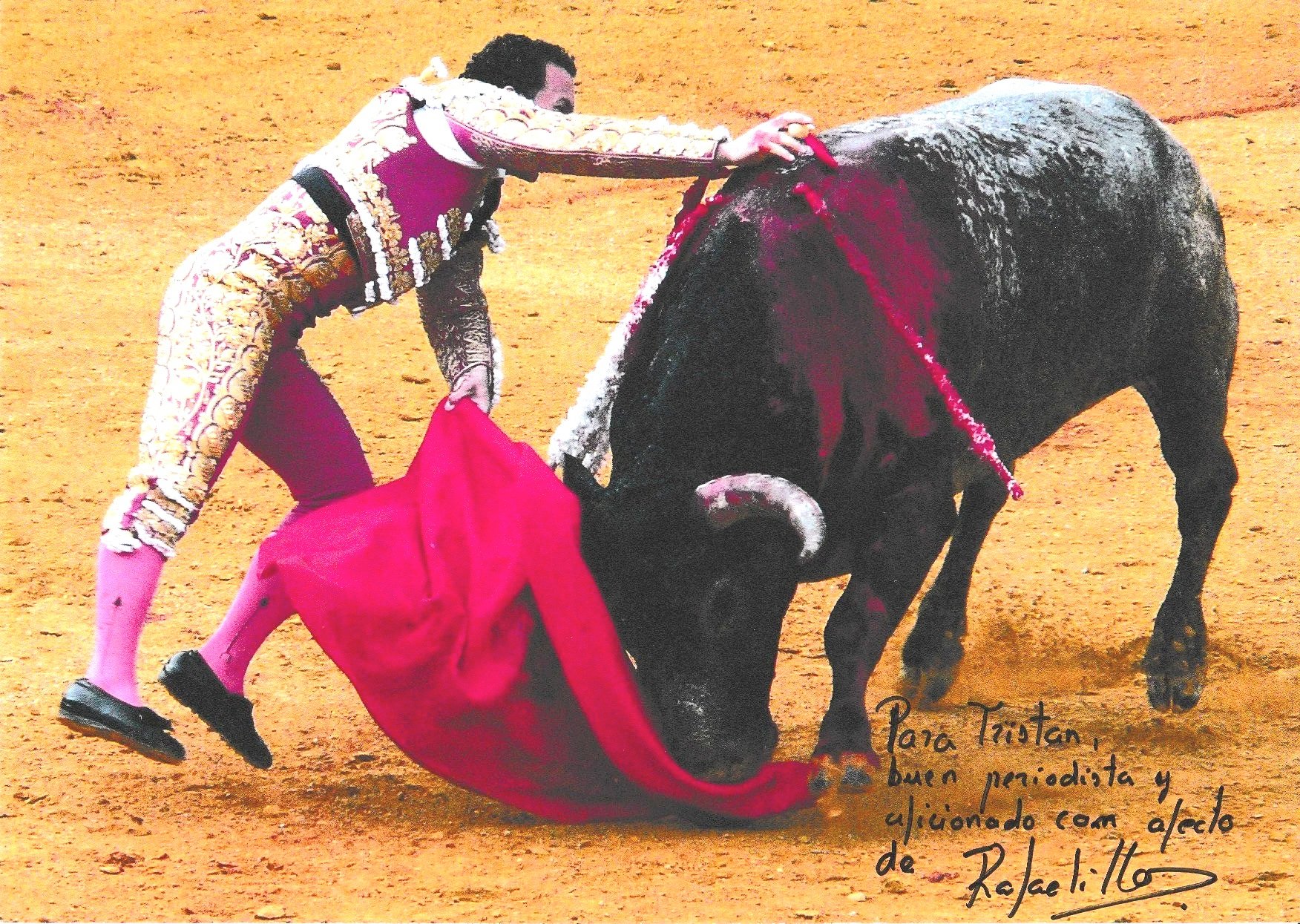
Rafaelillo killing
A general pattern on training for la suerte de matar emerges from the interviews, with a lot occurring at the stage when a matador is establishing their technique and possibly again when looking to recover from a period of poor killing, although the matadors’ views vary on this last point. Pepín Liria reveals he had a demountable carretón he could use to train in hotel rooms on the morning of corridas, when he would practise killing with it between 10 and 20 times (Borja Jiménez now has a similar carretón).
Although there are norms in killing, it also becomes clear that some matadors depart from them. For example, most toreros consider that the act of killing involves three distinct actions - entering [entrar], crossing [cruzar] and exiting [salir]. For El Fundi, however, entering and crossing are virtually simultaneous - “two movements in one”. “I start off with the left hand and the left leg at the same time., always with the left hand to the fore so that the muleta arrives at the bull before anything else. The muleta must reach the animal’s snout first, so that it lowers its head and ‘the door becomes open’. And then the right leg and right arm immediately come out and you execute la volapié.”
Another general rule with killing, which almost all the matadors interviewed here comply with, is not to look at the bull’s face or horns immediately before or during the suerte, but to concentrate on the killing spot. However, Daniel Luque is an exception: “I look at the horns, the bull’s eyes and its morrillo […] Many say that, in order to kill a bull well, you should focus just on one spot, but I’m not totally convinced about this. I can’t let my eyes rest solely on the morrillo, where the sword’s going to go: I need to see the animal, where it’s going to come towards me, what I have to do to it, its movement… Then there is a point at which you do lose sight of its head totally, but that’s during the crossing, after you’ve already put the leg and muleta forward. And that’s also the point when you’re focussed on the target for the sword.”
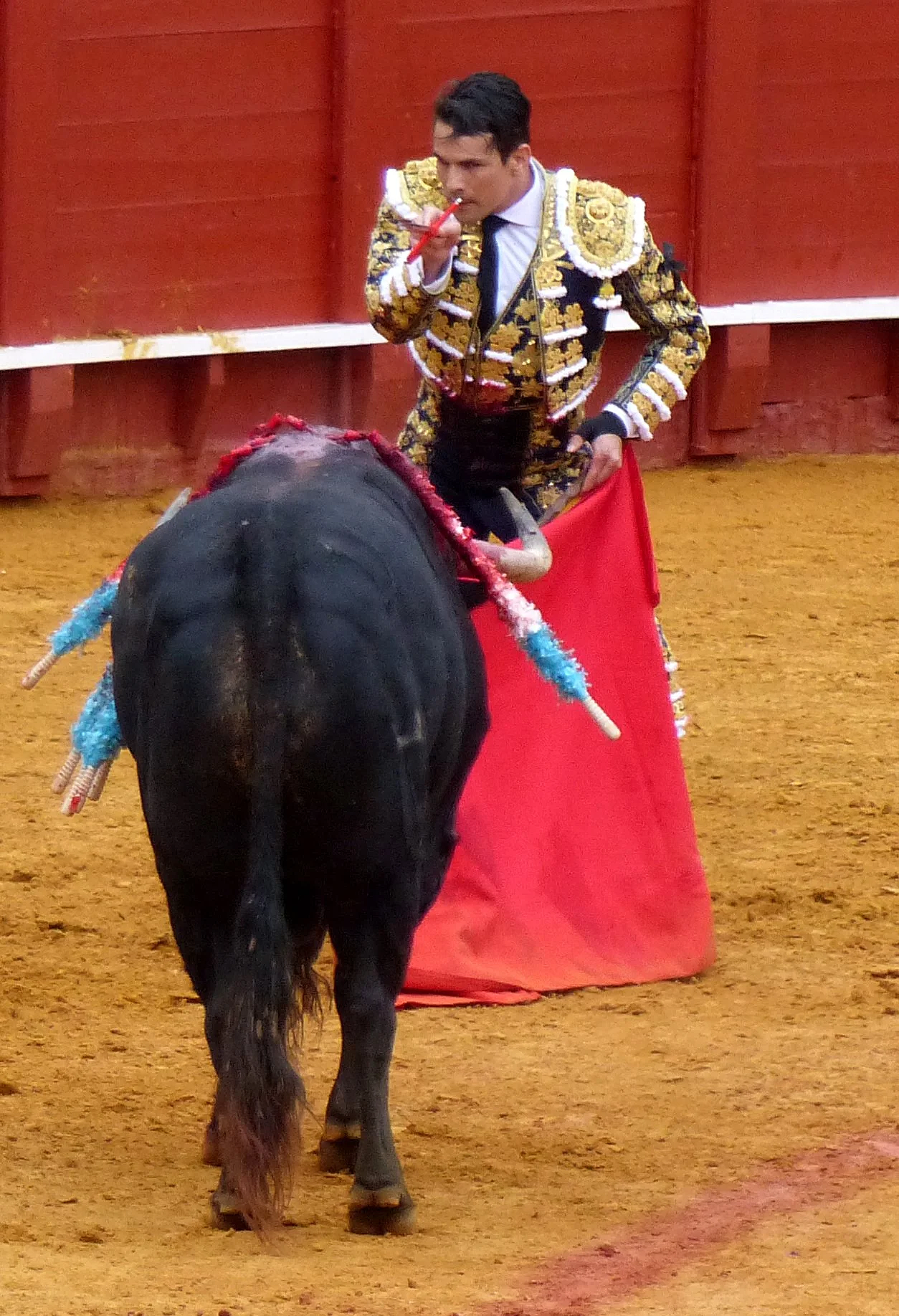
‘Ases de Espadas’ includes an explanation of José María Manzanares’ unusual turn of the wrist when citing for the kill, the crosspiece of the hilt almost vertical
There’s variety too in the numbers and types of estoques the matadors use. José María Manzanares, for example, tells how he selects four or five swords at the start of each season, informing his mozo de espadas which of these he most prefers to use. Sánchez Vara, on the other hand, has relied on one sword - his father’s - for the bulk of his career, although he now uses a modernised replica made for him by Manolo Sales.
In addition to those already mentioned, the book features contributions from César Rincón, Jesulín de Ubrique, Manuel Escribano, Paco Ureña, Emilio de Justo and Juan Ortega. With books of this type, there’s nearly always someone with a unique approach who is absent - in this instance, Antonio Ferrera comes to mind - but nevertheless ‘Ases de Espadas’ provides useful insights into la suerte de matar and the men who make their living from executing it.